EU and NATO leaders meet to counter rising Russian hybrid threats as provocations escalate
Ursula von der Leyen and Mark Rutte met on 2 September to confront rising Russian hybrid threats. Days later, a Russian frigate fired flares at a Danish helicopter and a drone was shot down over Lithuania. Von der Leyen called the incidents part of a broader pattern of aggression.
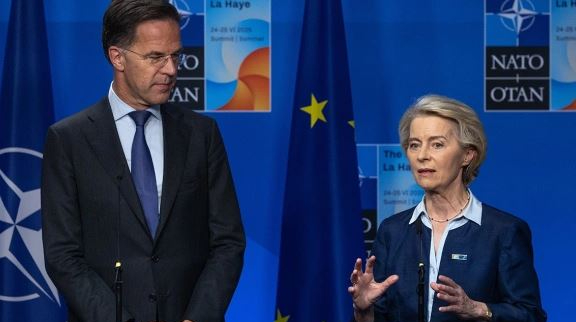
European Commission President Ursula von der Leyen and NATO Secretary General Mark Rutte met on 2 September 2026 to discuss the growing hybrid threat from Russia and ways to strengthen EU-NATO defence cooperation, as a series of provocative incidents along NATO's eastern flank underscores the urgency of their talks.
The meeting, announced at short notice by European Commission chief spokesperson Paula Pinho on 1 September, was framed as part of broader efforts to bolster European and transatlantic defence in the face of what Brussels describes as an intensifying campaign of Russian aggression short of open war.
"It is in this context as we strengthen our defense cooperation within Europe and with NATO," Pinho said, adding that the meeting was particularly important given the "increasing hybrid threats that we are seeing" Source: Ukrainska Pravda.
Pinho declined to specify the exact agenda but noted that Ukraine would inevitably feature in the discussions, given the war's consequences for European security. The meeting came as Kyiv continued to press allies for interceptor missiles to defend against Russian aerial attacks.
Just days after the von der Leyen-Rutte talks, a series of incidents along NATO's borders illustrated the very threats the two leaders had gathered to address.
On 14 September, a Russian frigate fired two signal flares towards a Danish Armed Forces helicopter, prompting Denmark to summon the Russian ambassador. The following day, NATO fighter jets shot down an unidentified drone that had entered Lithuanian airspace — the first such shootdown over the Baltic state.
Von der Leyen responded forcefully on 15 September, describing the events as part of a deliberate pattern.
"A Russian warship fired emergency flares dangerously close to a Danish helicopter. A drone entered Lithuanian airspace before being destroyed by NATO fighter jets. These are not isolated incidents. They are part of a broader pattern of Russian aggression and provocation against Europe, testing our readiness and our resolve," she wrote on X (Twitter) Source: Ukrainska Pravda.
The European Commission president warned that Russia would see "our resolve only growing stronger" and said Europe and NATO were "reinforcing our collective deterrence and defence" and "stepping up the pressure on Russia."
The incidents and the high-level meeting come against a backdrop of broader European defence recalibration. EU foreign policy chief Kaja Kallas recently established a high-level group of former political and military leaders from Europe and Ukraine to work on defence capabilities. Meanwhile, the Pentagon launched a six-month review of its military presence in Europe on 28 July, which could lead to a reduction in US troops on the continent — a development that adds urgency to EU-NATO efforts to fill any potential gaps.
While the von der Leyen-Rutte meeting focused squarely on Russian hybrid threats, unrelated developments in the Middle East — notably Houthi advances along Yemen's Red Sea coast and the seizure of the Bab al-Mandeb strait — have pushed oil prices above $100 a barrel and raised fears of a second front in the US-Iran conflict, further complicating the global security landscape Source: Al Jazeera. However, these events are not directly linked to the EU-NATO discussions on Russia.
What remains unclear is what specific operational measures the EU and NATO will adopt in response to the hybrid threats. The meeting produced no public communiqué or list of new initiatives, and Pinho had cautioned beforehand that she could not "prejudge what will be discussed specifically." Analysts expect the two organisations to deepen intelligence-sharing on hybrid warfare tactics, coordinate responses to GPS jamming and cyberattacks, and streamline procedures for rapid military reaction to incursions like the Lithuanian drone incident.
For now, the message from Brussels and NATO headquarters is one of unity and resolve. But as Russian probes of NATO's airspace and maritime boundaries become more frequent, the question is whether words will be matched by concrete, joint action.
Sources
- Von der Leyen and NATO secretary general will meet on 2 September to discuss rising hybrid threats from Russia September 1, 2026
- Will Houthi advances in Yemen give Iran leverage in its war with the US? September 12, 2026
- Von der Leyen on new Russian provocations: These are not isolated incidents September 15, 2026
Part of the dossier
Von der Leyen and NATO secretary general to discuss hybrid threats from Russia →