Kyiv's independence day show of unity masks defence funding gap and Polish tensions
Ukraine's 35th Independence Day saw European leaders in Kyiv, but a €27bn defence shortfall, Polish tensions over historical disputes, and an unconfirmed CIA visit to Moscow complicate the picture. Costa begins EU capital tour; NATO meets in Copenhagen in September.
Ukraine marked the 35th anniversary of its independence on 24 August with a display of European solidarity that papered over a looming €27 billion defence budget shortfall and festering bilateral tensions with Poland.
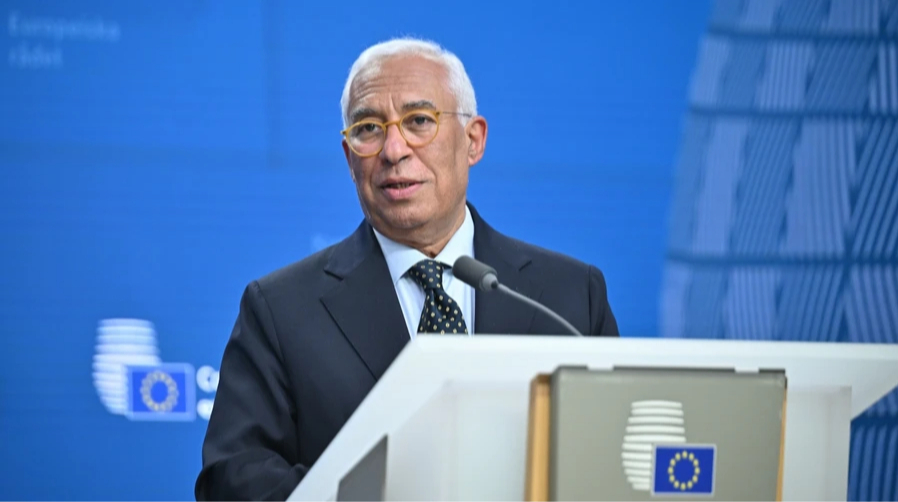
UK Prime Minister Andy Burnham, on his first overseas trip since taking office, laid a wreath in Kyiv alongside nearly a dozen other European leaders, including European Council President António Costa (The Guardian). The show of support was carefully choreographed to project unity, but the substance behind the symbolism is more complicated.
The €27bn question
President Volodymyr Zelenskyy used the occasion to tell a meeting of the Coalition of the Willing that Ukraine faces a €27 billion defence budget shortfall in 2026. One option he floated was early disbursement of part of the EU's €90 billion loan, which is currently scheduled for 2027 (Ukrainska Pravda).
But the European Commission says it has received no formal request from Kyiv for such front-loading. "We haven't received such requests formally," chief spokesperson Paula Pinho told reporters on 25 August, adding that the EU is disbursing the loan "at a very, very high speed rate" and "stands ready to accommodate requests to the largest extent possible" (Ukrainska Pravda).
The gap between Zelenskyy's public suggestion and the lack of a formal request suggests either a negotiating tactic or a failure of coordination between Kyiv and Brussels. Either way, the clock is ticking: the €90 billion loan was Kyiv's main financial lifeline for 2026-2027, and the €27 billion hole represents a significant chunk of Ukraine's total defence spending.
Costa's capital tour
Costa, who was in Kyiv on Independence Day, began a tour of EU capitals on 25 August to discuss "security and defence, Ukraine, EU enlargement, competitiveness, migration, current international issues, including the Middle East, and, of course, the EU's long-term budget for 2028-2034" (Ukrainska Pravda).
A senior EU official told European Pravda that the talks will cover "the full range of 'Ukrainian issues', including the opening of negotiating clusters and the provision of interceptor missiles for Ukrainian air defence systems" (Ukrainska Pravda).
Costa's itinerary for the week: 25 August – Slovakia, Estonia; 26 August – Lithuania, Latvia; 27 August – Czechia. Notably absent from the list are Poland, Germany and France, suggesting the tour is focused on the eastern flank rather than the heavyweight capitals.
Polish tensions
Poland's President Karol Nawrocki did not travel to Kyiv. Instead, he sent Zelenskyy a letter wishing Ukraine victory in the war but pointing to "points of tension" in bilateral relations, according to Marcin Przydacz, head of the Polish president's international policy bureau (Ukrainska Pravda).
Przydacz said the letter stressed that "Poland values good-neighbourly relations" but that they "must be based on certain fundamental principles, one of which is historical truth." He also criticised Ukraine's law on establishing a National Pantheon, saying it "will not help improve relations not only with Poland, but also with other countries and Western Europe as a whole" (Ukrainska Pravda).
The public airing of grievances by a key ally is a reminder that the solidarity displayed on Independence Day is fragile. Poland has been one of Ukraine's strongest supporters, but historical disputes over the Volhynia massacre and other issues continue to fester.
NATO's Copenhagen meeting
NATO's Military Committee will meet at the chiefs of defence level in Copenhagen on 18-19 September to discuss further military support for Ukraine, including follow-up measures from the Ankara summit where allies agreed to provide at least €140 billion in military support over 2026-2027 (Ukrainska Pravda).
The meeting will be chaired by Admiral Giuseppe Cavo Dragone and attended by Supreme Allied Commander Europe General Alexus Grynkewich and Supreme Allied Commander Transformation Admiral Pierre Vandier. The agenda includes "addressing the further strengthening of the alliance's collective deterrence and defence, innovation and technology, support for Ukraine" (Ukrainska Pravda).
Ratcliffe in Moscow
In a separate development, CIA Director John Ratcliffe was reported by CBS News to have arrived in Moscow for unannounced meetings on 25 August, citing sources familiar with the matter (Ukrainska Pravda). There has been no official confirmation. The last CIA director to visit Russia was William Burns in November 2021, who warned the Kremlin against invading Ukraine.
The visit comes after US Secretary of State Marco Rubio announced on 1 August efforts to explore resuming peace talks between Ukraine and Russia. Whether Ratcliffe's trip is part of that effort or something else remains unclear.
Russia's economic strain
Ukraine's UN representative Andrii Melnyk used the Independence Day UN Security Council meeting to argue that "Russia is losing and will lose this war," pointing to Russia's budget deficit which reached 5.8 trillion roubles (about $69 billion) in the first four months of 2026, significantly exceeding the government's planned deficit of 3.8 trillion roubles (about $45 billion) for the whole year (Ukrainska Pravda).
Russia's oil and gas revenues fell by almost 40% year on year in January-April 2026, according to its own finance ministry (Ukrainska Pravda).
Sanctions gaps
Ukraine's Defence Intelligence published data on 79 companies involved in producing Russia's Su-35S fighter jets, noting that 22 are not under sanctions (Ukrainska Pravda). The aircraft are used to intercept Ukrainian drones and cruise missiles, and to provide cover for Su-34 strike groups.
"Synchronising sanctions efforts against all elements of Russia's military-industrial complex is an important part of creating the conditions for a just peace in Ukraine and restoring stability in the world," DIU said (Ukrainska Pravda).
Cyberattacks on Norway
Pro-Russian hacker group Server Killers claimed responsibility for cyberattacks on Norway, saying they were in retaliation for Norway signing a strategic partnership agreement with Ukraine and continuing financial support for 2027 (Ukrainska Pravda). Norway's Digitalisation Agency has been under a major cyberattack for three days, disrupting dozens of government services.
The bottom line
Ukraine's Independence Day was a diplomatic success, but the real work begins now. Costa's tour, the Copenhagen meeting, and the unresolved question of the €27 billion gap will test whether the solidarity on display in Kyiv translates into concrete action.
Sources
- Ukraine's intelligence agency reveals data on Su-35S jets Russia uses to intercept Ukrainian drones and missiles August 25, 2026
- Andy Burnham lays wreath in Kyiv on Ukraine’s Independence Day – video August 24, 2026
- Nicola Jennings on Ukraine’s independence day – cartoon August 24, 2026
- Independence is defended by citizens every day August 24, 2026
- European Council president will begin tour of EU capitals: support for Ukraine on agenda August 24, 2026
- Ukraine's UN rep says Russia is losing war against Ukraine August 24, 2026
- NATO Military Committee to discuss support for Ukraine in Denmark on 18-19 September August 25, 2026
- European Commission: Kyiv has not asked EU for early funding to cover €27 billion defence budget shortfall August 25, 2026
- Prague rings Freedom Bell made from Russian weapons to mark Ukraine's Independence Day August 25, 2026
- CIA director has arrived in Moscow without prior announcement, CBS News says August 25, 2026
- Poland reveals what President Nawrocki wished Ukraine on Independence Day August 26, 2026
- Pro-Russian hackers claim responsibility for cyberattacks on Norway over support for Ukraine August 26, 2026
Part of the dossier
Ukraine Independence Day & European Leaders →