Russia Rushes Electronic Warfare System to Jam Starlink as Its Own Satellite Network Fails
Russia has begun mass-producing the Volna Kupol Garant electronic warfare system to jam Starlink, while its own satellite network Rassvet fails to reach orbit. NATO's Jammertest exercises in Norway counter satellite jamming threats, highlighting the electronic warfare race in Ukraine.
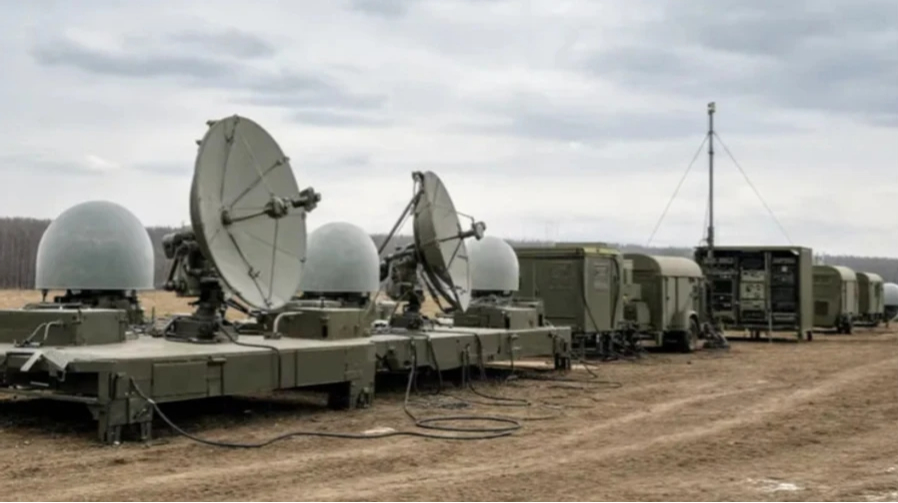
Russia has begun mass-producing an electronic warfare system designed to jam Starlink satellite communications, even as its own attempt to build a rival satellite constellation suffers a second catastrophic failure. The developments underscore the intensifying electronic warfare race in Ukraine and the growing reliance on commercial space assets for battlefield connectivity.
According to Kremlin-aligned news agency TASS, the Volna Kupol Garant system has entered mass production, with Russian officials claiming it “blinds” satellite receiving antennas using radio signals. The system, manufactured by the Russian company Russkii Kupol in occupied Simferopol, operates across eight satellite data transmission bands between 14 and 14.5 GHz, each with a bandwidth of 62.5 MHz, as reported by Ukrainian presidential adviser and radio technology expert Serhii “Flash” Beskrestnov. A single Volna Kupol Garant covers an area of roughly 20 square kilometres and is mounted on six trailers, each with two antennas.
Ukrainian forces have already targeted the system. OSINT analyst Dnipro Osint (Harbuz) published satellite images showing a destroyed Volna Kupol Garant at military unit No. 2156 in Gelendzhik, Russia. Ukrainian drone operators have also struck the system in the field, according to Beskrestnov’s photographs. The Russian claim that the system is effective in combat remains unverified by independent sources.
Russia’s rush to field a dedicated Starlink jammer comes as its own satellite internet project, the Rassvet constellation, falters. On 19 July, Russia launched 16 satellites aboard a Soyuz rocket, aiming for an operational altitude of 550 km. But as of 31 August, none had reached the target, according to the Institute for the Study of War (ISW) and satellite tracker N2YO, cited by Tom’s Hardware. Most satellites ended up at 300–400 km, with two already descending and expected to re-enter Earth’s atmosphere soon. This follows a first launch in March when only 12 of 16 satellites reached their planned orbit, and one has since fallen out of orbit.
Russia’s Starlink analogue is being developed by private company Bureau 1440, with plans to expand to 900 satellites by 2035. But the ISW estimates that at least 200–300 fully operational satellites are needed for stable round-the-clock connectivity over Ukraine. At present, Rassvet offers only two daily connectivity windows of up to 90 minutes each. The Kremlin accelerated the project after SpaceX, at Ukraine’s request, began blocking unregistered Starlink terminals in the region earlier this year.
Meanwhile, NATO and tech companies are pushing back. The annual Jammertest exercises were held in Norway in September 2026, focusing on countering satellite signal jamming that can affect aircraft, ships, and financial markets. Paul Rhys reported from Norway for Al Jazeera that defence and tech firms are testing countermeasures against the very type of jamming Russia is now deploying.
The three developments together paint a picture of a rapidly evolving electronic warfare landscape. Russia is investing heavily in jamming Western satellite communications while struggling to build its own independent network. Ukraine, for its part, continues to rely on Starlink for critical battlefield communications, and is working with SpaceX to tighten control over terminal access. NATO’s Jammertest exercises suggest the alliance is preparing for a future where satellite signals are routinely contested.
Sources: Ukrainska Pravda, Ukrainska Pravda, Al Jazeera
Sources
Part of the dossier
Russian Electronic Warfare and Starlink Jamming →