Russia unleashes wave of jet-powered drones and ballistic missiles, killing 12 in two nights of strikes
Russia launched two nights of massive drone and missile attacks on Ukraine, killing 12 people including an Indian national. The strikes used jet-powered drones and ballistic missiles against civilian infrastructure, with Ukrainian air defences downing 141 of 174 targets.
Russia has subjected Ukraine to two consecutive nights of large-scale aerial attacks, killing at least 12 people—including an Indian national—and wounding dozens more, Ukrainian officials reported. The assaults, which struck civilian infrastructure and residential areas from the Black Sea coast to the outskirts of Kyiv, underscore Moscow's continued reliance on mass drone and missile barrages to terrorise the population and degrade the country's energy grid.
Monday night: Boryspil and Kyiv hit hardest
On the night of 31 August–1 September, Russian forces launched a combined strike using jet-powered drones and ballistic missiles. President Volodymyr Zelenskyy confirmed on X (Twitter) that 12 people were killed, among them an Indian citizen. Dozens more were injured.
The city of Boryspil, in Kyiv Oblast, bore the brunt of the attack. An ordinary five-storey residential building was hit, forcing the evacuation of 50 people. Four people died and 13 were wounded in the city alone, according to the State Emergency Service. Businesses were also struck.
Across the capital region, nearly 350 rescue workers were deployed. In Kyiv itself, a railway depot was struck, killing seven people. Odesa and its surrounding region came under attack with guided aerial bombs and drones, leaving thousands of households without electricity. A border crossing point on the Romanian border and export infrastructure were deliberately damaged, Zelenskyy said.
Tuesday night: 174 drones and ballistic missiles target Odesa and Kyiv oblasts
The following night, starting at 18:00 on 1 September, Russia escalated further. The Ukrainian Air Force reported that the enemy launched 2 Iskander-M ballistic missiles from occupied Crimea, 2 Kh-59/69 air-launched missiles from the Black Sea, and 174 attack UAVs of various types. Around half of the drones were jet-powered, according to the Air Force. Among the UAV types identified were Shahed attack drones, S8000 Banderol missile drones, Gerbera drones and Parodiya decoy drones—the latter designed to confuse air defences.
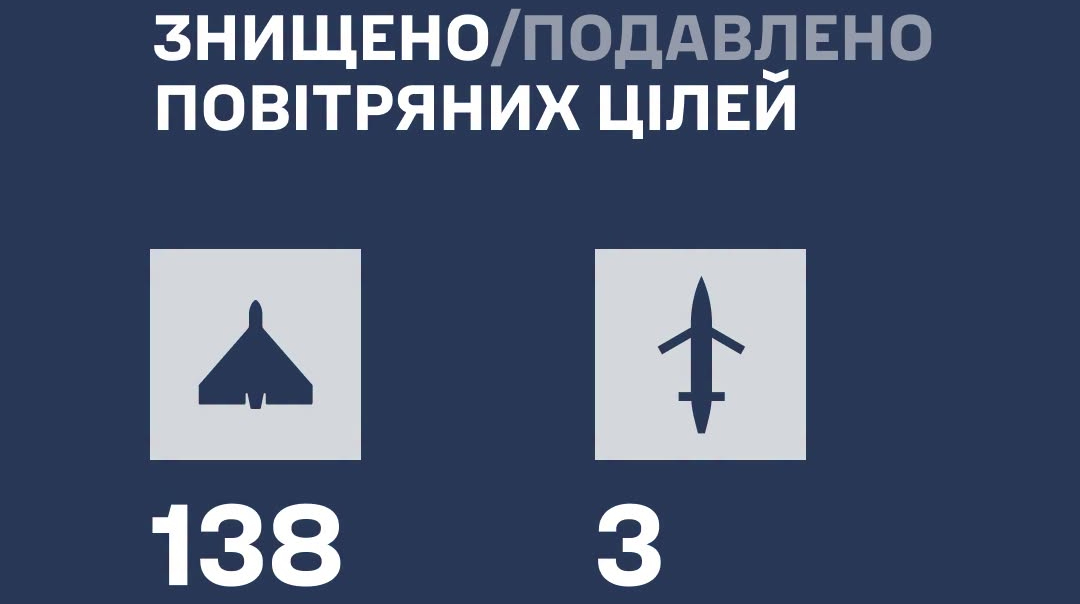
Odesa and Kyiv oblasts were the primary targets. Ukrainian air defence—including aircraft, anti-aircraft missile units, electronic warfare assets, unmanned systems units and mobile fire groups—managed to shoot down or jam 141 assets: 138 drones and three S8000 Banderol missile drones. The Air Force noted that Russian missiles and attack UAVs struck 16 locations, and debris from downed weapons fell at four more sites. Some Russian weapons failed to reach their targets altogether.
Tactical shift: jet-powered drones and decoys
The repeated use of jet-powered drones marks a tactical evolution. Unlike the slower, propeller-driven Shaheds, jet-powered UAVs are harder to track and intercept. The introduction of decoys such as the Parodiya drone suggests Russia is attempting to saturate and exhaust Ukrainian air defence systems—a pattern observed over the past weeks.
Ukrainian Air Force officials warned that the attack on the night of 1–2 September was still ongoing as of mid-morning, with some UAVs remaining in Ukrainian airspace. A separate attack on the night of 2–3 September saw 163 drones launched, of which 135 were shot down, though full casualty figures from that strike are not yet available.
Strategic significance
The scale and frequency of these strikes—three major barrages in as many nights—indicate that Russia has not abandoned its strategy of targeting Ukraine's civilian infrastructure and population centres. For Europe, the attacks serve as a reminder that Ukraine still lacks sufficient air defence coverage, particularly against ballistic missiles and high-speed drones. The killing of an Indian national also introduces a potential diplomatic dimension, as New Delhi has generally maintained a neutral stance on the war.
President Zelenskyy reiterated that Russia "plans its strikes specifically to cause as much destruction to people's lives as possible, and it succeeds only when air defence capabilities are insufficient." He thanked rescue workers and called for more Western air defence systems.
The coming days will likely bring a clearer picture of the damage from the latest wave, but for now, the toll is unequivocal: Russia continues to wage an aerial war that respects no distinction between military and civilian.
Sources
- Zelenskyy: Russia kills 12 Ukrainians and foreign national in overnight attack September 1, 2026
- Russia attacks Ukraine with missiles and drones, air defence downs 141 assets September 2, 2026
- Russia attacked Ukraine with 163 drones overnight, 135 shot down September 3, 2026
Part of the dossier
Russian Attacks on Ukraine →