Russia pounds Ukraine with massive strikes as Kryvyi Rih search enters fourth day, three still missing
Russian forces launched massive strikes on Kramatorsk, Konotop, Chernihiv, and Kharkiv, while the search for survivors in Kryvyi Rih entered its fourth day with three people still missing, including a child. A Red Cross warehouse in Kherson was destroyed, and two miners were killed in Dnipropetrovsk Oblast.
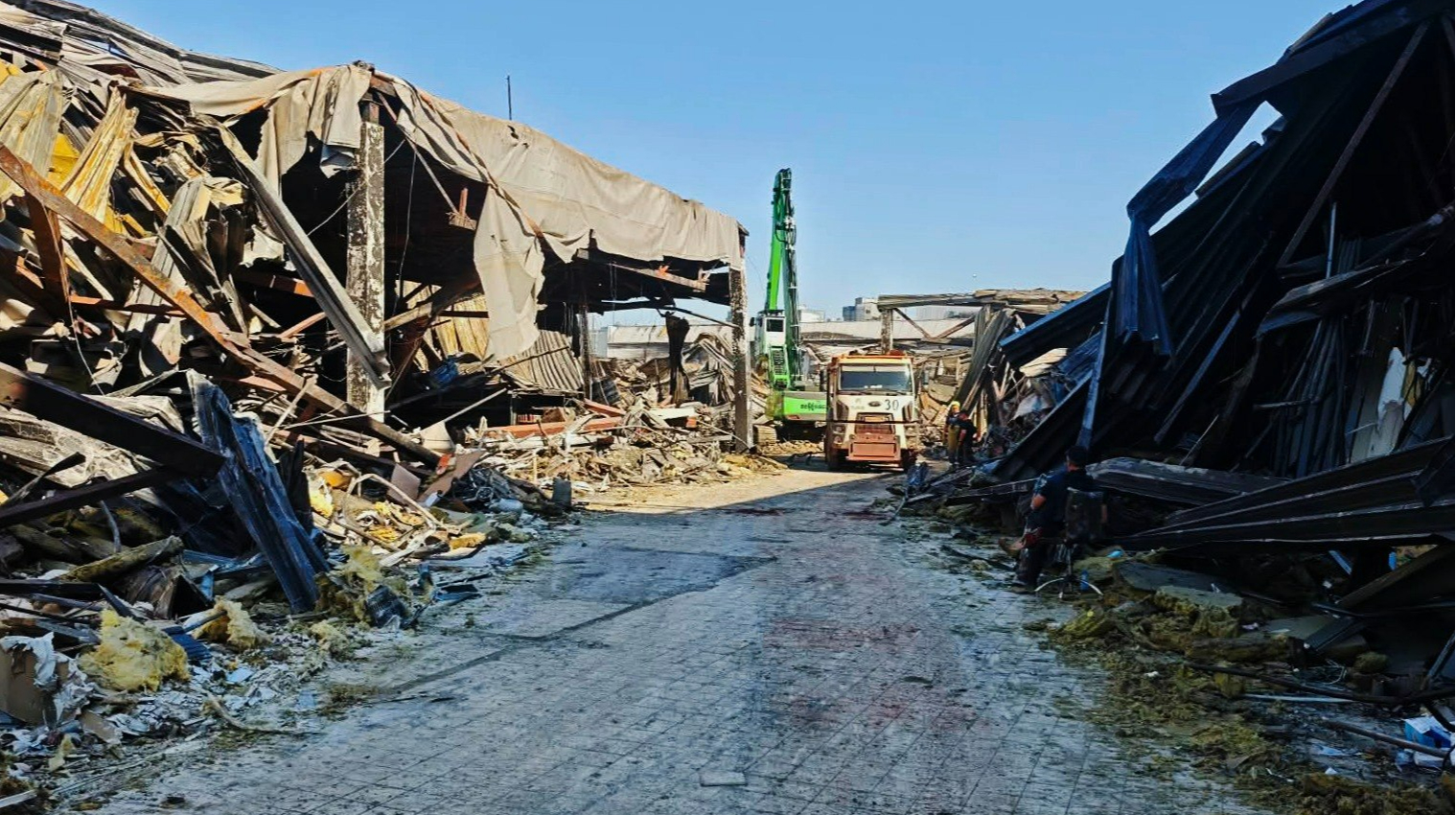
Russian forces have carried out a wave of strikes across Ukraine over the past 48 hours, hitting residential areas, railway infrastructure, a border crossing, and a Red Cross warehouse, while the search for survivors in Kryvyi Rih entered its fourth day with three people still missing, including a child.
In Kryvyi Rih, Dnipropetrovsk Oblast, the State Emergency Service (SES) continues to comb through the rubble of a shopping centre destroyed by a Russian double-tap drone strike on 21 August. As of 24 August, 16 people were confirmed dead and 136 injured, 26 of them children. Three people – one of them a child – remain unaccounted for. The SES deployed 185 emergency workers, 42 pieces of heavy equipment, and eight sniffer dogs from four regions to the site. Crews have dismantled 1,900 square metres of damaged structures and searched over 1,000 square metres. Forty-nine of the wounded are still hospitalised, 15 in serious or critical condition.
On 25 August, a massive Russian airstrike hit Kramatorsk in Donetsk Oblast. Oleksandr Honcharenko, head of the city’s military administration, reported that residential neighbourhoods and apartment blocks were struck and people were injured. The number of casualties was still being clarified as of the evening. The attack follows a similar pattern to a 20 August strike on Kramatorsk and Sloviansk using guided bombs that killed two and injured 11.
Russian forces also struck the city of Konotop in Sumy Oblast on the night of 24–25 August. Mayor Artem Semenikhin said a 14-year-old girl was injured, dozens of buildings were damaged, and a family home was destroyed. The attack hit an agricultural business and railway infrastructure, including a section of track and facilities belonging to state railway operator Ukrzaliznytsia, leaving parts of the city without gas supply.
Chernihiv Oblast suffered heavy bombardment over the same period. On 24 August alone, Russian forces carried out 45 attacks, including 16 drone strikes and 22 FPV drone hits, injuring 38 people, among them children and teenagers, according to regional governor Viacheslav Chaus. A strike on a residential building in Chernihiv city injured 25 people. A separate attack on the town of Mena with a strike drone hit a telecommunications building, wounding 12 people, including four teenagers. On the night of 25–26 August, Russian drones again struck Chernihiv, hitting a warehouse and injuring four people, with reports of people possibly trapped under rubble. Earlier that morning, a drone attack on a residential building killed a 49-year-old woman and a four-year-old girl. Fires also broke out at businesses in the Koriukivka district, where a fire spread over 3,000 square metres before being extinguished.
Kharkiv came under missile fire overnight on 24–25 August. Mayor Ihor Terekhov reported that a missile struck an industrial area in the Osnovianskyi district, killing one person. The following afternoon, Russian forces used an FPV drone to kill two men – aged 50 and 51 – in the village of Slatyne, just north of Kharkiv. Viacheslav Zadorenko, head of the Derhachi city military administration, said the men were clearing debris from a previous strike when the Russians deliberately targeted them. A second FPV drone later struck a house, causing a fire that firefighters could not reach because of the risk of repeat attacks.
Russia also struck the Vynohradivka international road border crossing with Moldova using a Shahed drone on the night of 24–25 August. The State Border Guard Service reported that infrastructure was damaged and the crossing has been temporarily closed. Traffic is being rerouted to other checkpoints.
In Kherson, a Russian drone attack on the evening of 23 August hit a warehouse belonging to the Ukrainian Red Cross. The organisation said the fire caused damage worth nearly UAH 28 million (about US$627,000), destroying supplies meant for winter preparation and emergency response, including medical kits, blankets, hygiene items, and equipment for providing water and electricity. The warehouse also held materials for covering damaged buildings.
On the night of 25–26 August, a Russian drone struck a car carrying two miners from DTEK, Ukraine’s largest private energy company, as they were returning home after their shift in Dnipropetrovsk Oblast. Vitalii Semenov, 52, and Illia Rusanenko, 48, were killed. Both men leave behind wives, children, and parents. The attack comes amid a pattern of Russian strikes on energy infrastructure: on 17 August, a large-scale drone attack hit a DTEK mine site, and in July, a security worker was killed and five others injured in another mine office attack.
According to the General Staff of the Armed Forces of Ukraine, Russia lost 1,230 soldiers killed and wounded over the past day, bringing total estimated personnel losses since February 2022 to approximately 1,479,300. Equipment losses included 9 armoured combat vehicles, 48 artillery systems, and 1,555 operational-tactical UAVs.
These strikes – hitting residential areas, transport hubs, energy infrastructure, and humanitarian aid – underscore Russia’s continued strategy of targeting civilian infrastructure far from the front line. The Kryvyi Rih search operation, with its painstaking work by sniffer dogs and emergency crews, is a grim reminder of the human cost. The missing child and two adults, the 14-year-old girl in Konotop, the four-year-old killed in Chernihiv – they are not numbers from a wire summary but specific, named victims of a war that shows no sign of abating.
Sources
- Day four of search operation after Russian strike on Kryvyi Rih: three people still missing August 24, 2026
- Russians attack border crossing with Moldova: Vynohradivka checkpoint temporarily closed August 25, 2026
- Russia loses 1,230 soldiers over past day August 25, 2026
- Russia attacks business in Chernihiv Oblast, fire spreads over 3,000 sq m – photos, video August 25, 2026
- Russia attacks Red Cross warehouse in Kherson, causing nearly US$627,000 in damage – photos August 24, 2026
- Russians attack Kharkiv with missiles, person killed August 24, 2026
- Russian strike on Konotop leaves parts of city without gas, destroys agricultural business and railway facilities August 25, 2026
- Russians carry out massive airstrike on Kramatorsk: people injured August 25, 2026
- Russian attacks on Chernihiv Oblast over past day leave 38 people injured – photos August 25, 2026
- Russians kill two people in Kharkiv Oblast in FPV drone strike August 25, 2026
- Russians strike Chernihiv again: four injured, people may be trapped under rubble August 26, 2026
- Russians kill two miners in Dnipropetrovsk Oblast August 26, 2026
Part of the dossier
War in Ukraine: Casualties and Rescue Operations →