Russia requests more powerful North Korean missiles and up to 50,000 troops as new road bridge opens
Ukraine's Defence Intelligence reports Russia has asked North Korea for 120 KN-30 ballistic missiles and up to 50,000 troops, though no transfer has been recorded. Meanwhile, the first road bridge between the two countries opened on 7 September, which Ukrainian investigators suspect will serve as a covert military logistics route for Russia's war effort.
Russia has asked North Korea for a new batch of ballistic missiles and a large contingent of troops, Ukraine’s Defence Intelligence (DIU) reported on 27 August, while the first road bridge between the two countries opened on 7 September – a link Ukrainian investigators believe is intended as a covert military logistics corridor for Moscow’s war effort.
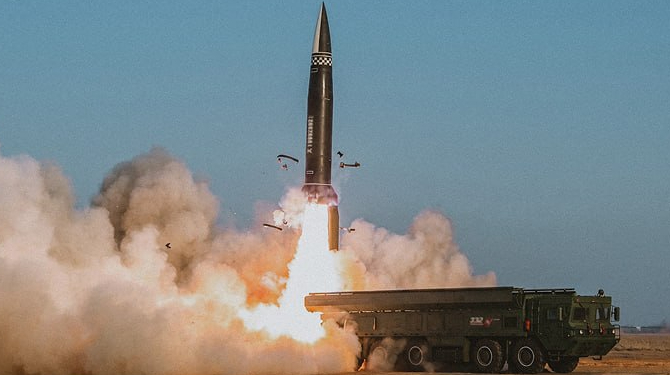
According to Andrii Cherniak, a DIU representative, Moscow has requested 120 KN-30 ballistic missiles – a model three times more powerful than the KN-23/24 missiles North Korea has already supplied – along with six launchers, a missile unit of up to 90 personnel, and a contingent of 30,000 to 50,000 North Korean troops. “However, no transfer of these missiles from North Korea to Russia has been recorded so far,” Cherniak told Liga.net Source: Ukrainska Pravda. He added that Russia has already received 40 KN-23/24 missiles and used two of them in recent attacks on Ukraine. The final volume of North Korean assistance is expected to be determined during talks between the two countries’ leaders in September.
The DIU’s report comes as Russia and North Korea opened the first road bridge across the Tumen River on 7 September. The one-kilometre, two-lane bridge was inaugurated with a video-link ceremony attended by Russian Prime Minister Mikhail Mishustin and North Korean Premier Pak Thae Song. Mishustin said up to 300 vehicles and 2,323 people could cross daily, and that the bridge would be linked to Russia’s federal road network Source: Al Jazeera. North Korean state media described it as a tool for “personnel exchanges, tourism and trade” Source: BBC News.
But Ukrainian investigative group Truth Hounds, citing satellite imagery from May 2026 showing new access roads and border infrastructure, said the bridge is intended “primarily to establish a covert military logistics corridor” to support Russia in the Ukraine war Source: BBC News. The bridge replaces a makeshift road link that used wooden planks laid over the existing rail bridge, and its opening follows years of deepening military cooperation between Moscow and Pyongyang since Russia’s full-scale invasion of Ukraine in 2022.
The timing is significant. With the DIU warning that Russia is negotiating a new package of military assistance ahead of the autumn-winter campaign, the bridge could become a key artery for moving North Korean munitions and possibly personnel into Russian territory. South Korean intelligence researchers have previously noted that North Korea has already supplied artillery shells and ballistic missiles to Russia, and the new road link would allow faster, higher-volume transfers than the existing rail and air routes.
For Ukraine, the prospect of North Korean troops fighting alongside Russian forces – even if not yet confirmed – and the arrival of more powerful KN-30 missiles would mark a serious escalation. The KN-30’s greater range and payload would allow Russian forces to strike deeper into Ukrainian territory and with heavier warheads. The DIU’s Cherniak said the Kremlin is asking for a missile unit of up to 90 personnel, which suggests North Korean operators might be deployed to handle the new systems, though their exact role remains unclear.
Kyiv and its allies have repeatedly warned against deepening military ties between Moscow and Pyongyang. The United States and European Union have imposed sanctions on entities involved in arms transfers, but the new bridge – officially a civilian infrastructure project – could complicate efforts to monitor and interdict military supplies.
As the bridge becomes fully operational for passenger traffic by the end of 2026, Ukrainian investigators will be watching closely for any signs that North Korean materiel or troops are crossing the Tumen River. For now, the bridge stands as a concrete symbol of the Russia-North Korea partnership – and as a potential new front in the logistics of Russia’s war.
Sources
Part of the dossier
Russia-North Korea Missile Cooperation →