Russian Strike Damages Forest Administration Building in Zaporizhzhia as Attacks on Civilian Infrastructure Continue
On 4 September 2026, Russian forces struck the administrative building of the Zaporizhzhia Forest Branch, causing structural damage. The attack is part of a recent wave of Russian strikes on civilian infrastructure in Ukraine, including a shopping centre in Sumy and an industrial facility in Dnipro. No casualties have been reported.
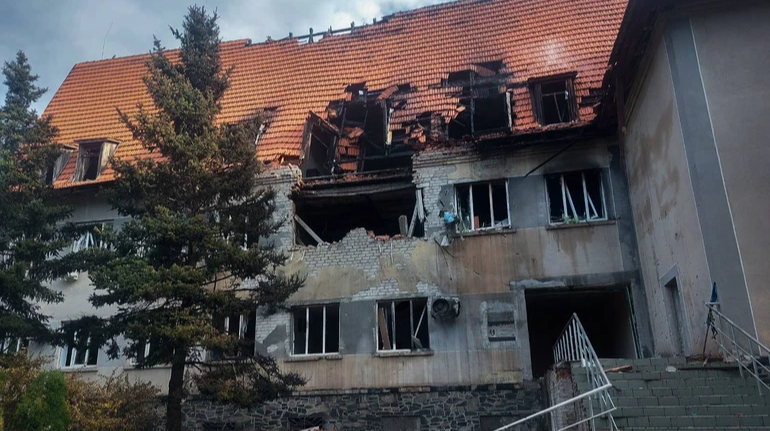
Russian forces struck the administrative building of the Zaporizhzhia Forest Branch in Zaporizhzhia Oblast on 4 September, damaging the facility, according to photographs published by Ukrainska Pravda. No casualties have been reported, and the specific weapon used in the strike has not been confirmed.
The building, which houses the regional forestry management office, is a civilian administrative site with no apparent military function. The attack fits a broader pattern of Russian strikes on non-military infrastructure in Ukraine that has continued into early September. In the same week, Russian forces struck a shopping centre in Sumy on 10 September, causing it to suspend operations, as reported by Ukrainska Pravda. Two days later, on 12 September, a strike on the city of Dnipro sparked a fire at an industrial facility, according to the same outlet.
The Zaporizhzhia strike is the latest in a series of attacks that target Ukrainian civilian infrastructure far from the front line. While forest administration buildings are not typical military objectives, their destruction disrupts local governance and resource management. The Zaporizhzhia Forest Branch oversees forestry, fire prevention, and conservation in the region — functions that are critical for both civilian life and the wartime economy.
Ukraine’s State Emergency Service and regional authorities have not yet issued detailed damage assessments. Photographs from the scene show a two-storey building with its roof partially collapsed and windows blown out, suggesting a direct hit likely from a missile or drone. No claims of responsibility have been made by the Russian Ministry of Defence, which often describes strikes on Ukrainian infrastructure as targeting “energy facilities” or “military command posts.”
The strikes on Sumy and Dnipro underscore the geographic spread of Russian attacks. The Sumy shopping centre, located in the northeast near the Russian border, had already scaled back operations due to previous shelling. The industrial facility in Dnipro, a major industrial hub in central-eastern Ukraine, caught fire after what local authorities said was a missile hit. No casualties were reported in either incident.
These attacks occur against a backdrop of sustained Russian missile and drone campaigns aimed at Ukraine’s energy grid and civilian infrastructure. Since autumn 2022, Moscow has repeatedly targeted power plants, heating facilities, and administrative buildings to pressure the Ukrainian government and population. The Zaporizhzhia Forest Branch strike appears to be a continuation of that tactic, even as military operations concentrate in Donetsk and Kharkiv regions.
For now, the damage in Zaporizhzhia is limited to property. The absence of casualties is likely due to the building being struck outside of working hours, though no official statement has confirmed that. Ukraine’s Air Force has not released details on how many missiles or drones were launched on 4 September, nor on interception rates.
The Zaporizhzhia region remains a regular target due to its proximity to the front line, which runs roughly 50 kilometres to the south-east. Russian forces have occupied parts of the oblast since 2022, and the administrative seat of the region’s government has relocated to Zaporizhzhia city. The forest branch building is located within the city limits, underscoring the constant threat to civilian infrastructure even in relatively protected urban areas.
As the war enters its third year, such attacks — while small in scale compared to the grinding front-line battles — demonstrate Russia’s willingness to degrade Ukraine’s peacetime institutions. Each strike on a civilian building, whether a forestry office or a shopping centre, adds to the cumulative burden on Ukrainian society and infrastructure.
Sources
- Russian forces strike forest administrative building in Zaporizhzhia Oblast – photos September 4, 2026
- Russian forces strike Sumy shopping centre again after it suspends operations September 10, 2026
- Russian forces strike Dnipro, sparking fire at industrial facility September 11, 2026
Part of the dossier
Russian forces strike forest administrative building in Zaporizhzhia →