Ukraine’s Drone Arsenal Grows: New Naval Mothership, Jet-Powered UAVs, and Deep Strikes Inside Russia
Ukraine unveiled the Magura V11 naval drone, a new FPV strike drone, and a jet-powered UAV set for European production, while striking a Russian oil refinery, a Wildberries hub, and a $100m radar system. The developments show a rapidly industrialising drone sector with increasingly sophisticated capabilities.
Ukraine’s unmanned systems sector is scaling up at a pace that few defence analysts predicted even a year ago. In the past two weeks alone, Ukrainian forces have unveiled a new naval drone that can launch other drones, a jet-powered UAV set for European production, and a compact FPV strike drone designed for assault units — while simultaneously executing long-range strikes on a Russian radar, a major oil refinery, and a Wildberries logistics hub. The message is clear: Ukraine is industrialising its drone warfare and taking the fight deeper into Russian territory.
A naval platform that changes the game
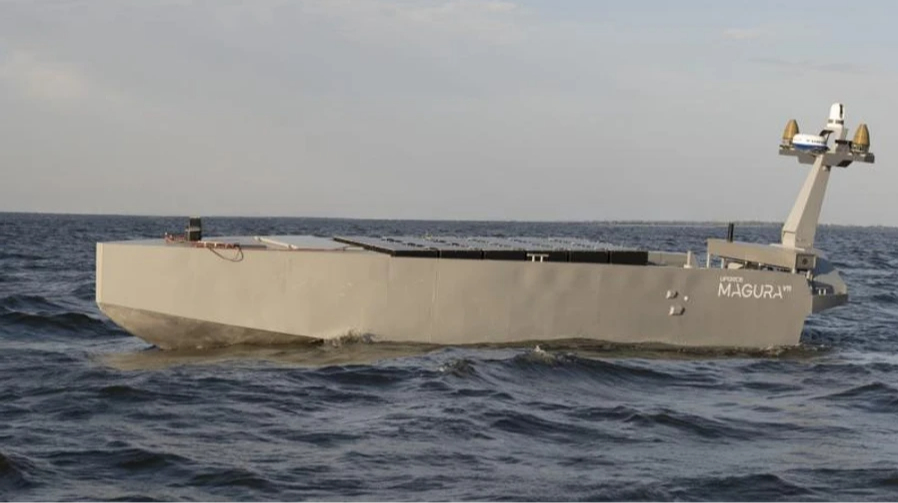
On 25 August, Ukrainian company UForce unveiled the Magura V11, the largest drone in the Magura family, during an Independence Day parade on the Dnipro River. Unlike its predecessors, the V11 is a transport platform with a payload capacity of 2,200 kg and a stated endurance of up to seven days. Its critical feature: the ability to carry and launch other unmanned systems from aboard, effectively acting as a mobile maritime base. According to the developers, the V11 is designed for reconnaissance, support for amphibious operations, and the supply of fuel and equipment to other uncrewed maritime systems. The platform was developed by UForce’s design bureau in Portugal with international investment and is intended to meet the operational needs of Ukraine’s defence forces (Ukrainska Pravda).
This is a significant step beyond the original Magura V5, which has been used in Black Sea operations. A mothership that can deploy smaller drones far from shore could change the calculus for naval operations, especially in the western Black Sea, where Russian patrols remain a threat.
Jet-powered drones go European
On 7 September, it was reported that Ukrainian Bars jet-powered drones are set to be manufactured in Europe. No specific country or timeline was given, but the move signals a shift from prototype to serial production. Jet-powered drones offer higher speed and altitude than propeller-driven models, making them harder to intercept and more suitable for deep-strike missions. European production also reduces reliance on Ukrainian factories, which are under constant threat of Russian missile strikes (Ukrainska Pravda).
Compact FPV for close-range work
F-Drones, the company behind the F10 strike drone that became a finalist in the US Pentagon’s Drone Dominance programme, has released a smaller model: the F5. Designed for assault units, the F5 is a five-inch carbon-frame FPV drone with a payload of up to 1 kg and a tactical range of 13 km in its radio version, or 6 km in a fibre-optic configuration that is immune to electronic warfare. The fibre-optic variant is a direct response to the dense Russian EW environment, which has crippled many commercial drones. The F5 is small enough that several units can be carried in a single backpack, and a ground robotic system can deliver nine to a position at once. The drone has been codified by Ukraine’s Defence Ministry (Ukrainska Pravda).
Wild Hornets boosts range by 50%
Wild Hornets, a Ukrainian company known for its Sting interceptor drones, has developed the HV VTX Pro video transmitter. With a maximum output power of 4W — double that of previous models — the module increases the effective operating range of FPV and interceptor drones by up to 50%. According to the company, the operating radius of interceptor drones could rise from 20 km to 30 km under favourable conditions. The more powerful transmitter also improves stability when EW systems are active, and pilots estimate that intercepting low-altitude targets could become at least 20% more effective (Ukrainska Pravda).
Deep strikes: refinery, logistics hub, and a $100m radar
While the technology news is impressive, the operational results are tangible. On the night of 25-26 August, Ukrainian Special Operations Forces (SOF), working with the Unmanned Systems Forces, struck the Lukoil-Nizhegorodnefteorgsintez oil refinery in Kstovo, Nizhny Novgorod Oblast. The refinery is Russia’s fourth-largest by capacity, processing about 17 million tonnes of crude oil per year, and supplies up to 11% of Russia’s petrol. A fire was confirmed at the facility (Ukrainska Pravda).
The same night, Ukrainian drones destroyed a Wildberries logistics centre in Kotovsk, Tambov Oblast. Governor Yevgeny Pervyshov said the facility was “utterly destroyed” by fire after being hit by nine UAVs, six of which were shot down. Two people were injured. The Wildberries press service said the warehouse had been evacuated in advance, but the loss of one of the marketplace’s main logistics hubs will disrupt supply chains across central Russia (Ukrainska Pravda).
On 27 August, the 429th Separate Brigade of Unmanned Systems Akhilles released footage of a strike on a Russian Nebo-U radar system at Millerovo airfield in Rostov Oblast. The attack was carried out with a Ukrainian RAM-2X kamikaze drone from 170 km from the line of contact. The Nebo-U is a three-coordinate VHF-band radar designed to detect aircraft, cruise missiles, and ballistic missiles. Its antenna height is 43 metres, and the system is estimated to cost $100 million. The brigade noted that the loss of the radar will reduce Russia’s ability to detect aerial targets in the station’s operational zone — a zone that covers the approach routes for Shahed drones launched at Ukraine (Ukrainska Pravda).
Why this matters
Ukraine is not just flooding the battlefield with cheap FPV drones; it is building a layered unmanned capability: interceptor drones to counter Russian reconnaissance, long-range strike drones to hit strategic targets hundreds of kilometres away, and naval motherships to project power at sea. The European production of Bars drones and the integration of EW-resistant transmitters signal that this is a sustained industrial effort, not a stopgap. For the Russian military, the message is that no rear area is safe, and the cost of air defence is becoming unsustainable.
What remains to be seen is whether Ukraine can scale production fast enough to sustain these operations through the autumn and winter, and whether Russia will adapt its EW tactics to counter the new fibre-optic drones. But for now, the trend is clear: Ukraine’s drone sector is iterating faster than the adversary can respond.
Note: This article synthesises information from multiple Ukrainian sources. All claims are attributed to the respective military units, companies, or officials.
Sources
- Ukrainian company Wild Hornets develops module that can increase drone operating range by up to 50% – photos August 25, 2026
- Ukrainian company UForce unveils new Magura naval drone that can launch other unmanned systems August 25, 2026
- Ukrainian F-Drones unveils new FPV strike drone for assault units August 25, 2026
- Why India is sharing missile secrets with its private sector August 26, 2026
- Ukrainian drones behind attack on Russian Kstovo oil refinery overnight August 26, 2026
- Ukrainian drones have utterly destroyed Wildberries logistics centre in Kotovsk, Russian governor says – photo, video August 26, 2026
- Ukrainian military shows their drone strike on Nebo-U radar at Russia's Millerovo airfield – photo, video August 27, 2026
- Ukrainian Bars jet-powered drones to be manufactured in Europe September 7, 2026
- Ukrainian Armor unveils Saigak-1 and Varta 3 armoured vehicles – photos September 8, 2026
Part of the dossier
Ukraine Military Technology and Drones →