Ukraine's new drone wave: Magura V11 mothership, F5 strike drone, and an EW-resistant transmitter
Three Ukrainian firms unveiled new drones on 25 August: a 2,200 kg naval mothership, a compact FPV, and a transmitter boosting range by 50%. The shift: larger platforms and EW resilience.
On 25 August, three Ukrainian defence companies announced new drone systems, offering a glimpse of where the country's unmanned fleet is heading: larger platforms that can carry other machines, compact strike drones built for close-quarters combat, and components designed to survive heavy electronic warfare.
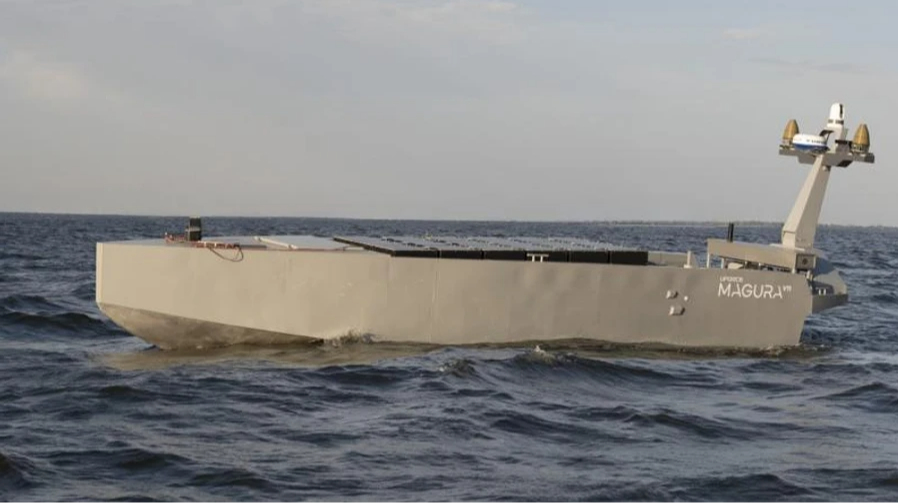
The most ambitious of the three is the Magura V11, a naval drone from UForce that the company says is the largest in its class. Unveiled during an Independence Day parade on the Dnipro River, the V11 is designed as a transport platform with a payload capacity of up to 2,200 kg and an endurance of up to seven days. Its defining feature is the ability to carry and launch other unmanned systems from aboard, effectively acting as a mobile maritime base far from shore.
UForce CEO Oleh Rohynskyi framed the V11 as a multi-domain enabler: “A single carrier that transports and launches other unmanned systems far from shore for operations across all domains.” The company says the platform can handle reconnaissance, support amphibious operations, and supply fuel and equipment to other uncrewed maritime systems around the clock and in all weather. The drone was developed by UForce's design bureau in Portugal with international investment. Source: Ukrainska Pravda
The strategic implication is clear: Ukraine's naval drone force, which has already been used to strike targets in the Black Sea, is moving from single-mission attack craft toward motherships that can extend the reach of smaller systems. The V11's ability to operate for a week at sea, if the company's claims hold up, would allow Ukraine to maintain a persistent unmanned presence far from its coasts. The U.S. company ReconCraft is already set to manufacture Magura platforms in the United States in partnership with UForce, suggesting the system is being prepared for broader production.
At the other end of the spectrum, F-Drones unveiled the F5, a compact FPV strike drone designed for assault units. The five-inch carbon-frame drone carries up to 1 kg of payload and is built for short-range work in “forested areas, urban areas, and supporting positions and assault groups,” the company said. It comes in two variants: one with a jam-resistant radio link and one with a fibre-optic control link that is immune to electronic warfare. The radio version has a stated tactical range of up to 13 km; the fibre-optic version flies about 6 km. Source: Ukrainska Pravda
The F5 is already codified by Ukraine's Defence Ministry, meaning it can be procured for the armed forces. Its small size is a logistics advantage: several drones fit in a backpack, and a ground robotic system can deliver nine to a position at once. F-Drones is no newcomer — its F10 strike drone became the second Ukrainian finalist in the first stage of the U.S. Pentagon's Drone Dominance programme in March 2026.
The third announcement addresses a problem that has plagued drone operations since the start of the war: electronic warfare. Wild Hornets, the company behind the Sting interceptor drone, has developed the HV VTX Pro video transmitter, a module that more than doubles output power to 4W. According to the company, the new transmitter increases the maximum effective operating range of both interceptor and FPV drones by up to 50% under comparable conditions. For interceptor drones, that means a potential operating radius of 20 to 30 km with an omnidirectional antenna. Source: Ukrainska Pravda
Wild Hornets also claims the more powerful module improves the stability and quality of video transmission when electronic warfare systems are operating, and that pilots estimate it could increase the effectiveness of intercepting low-altitude targets by at least 20%. That matters because Russian EW has been one of the most effective counters to Ukrainian FPV drones; a stronger video link is a direct response to that threat.
Taken together, the three announcements suggest a drone industry that is maturing in different directions: naval motherships for multi-domain operations, lightweight FPVs for infantry, and component-level upgrades to keep existing systems viable against EW. All of these are company claims, and none have been independently verified in combat. The open questions are the usual ones for Ukrainian defence tech: when will these systems reach units in quantity, and how will they perform against Russian countermeasures once they do?
Sources
- Ukrainian company Wild Hornets develops module that can increase drone operating range by up to 50% – photos August 25, 2026
- Ukrainian company UForce unveils new Magura naval drone that can launch other unmanned systems August 25, 2026
- Ukrainian F-Drones unveils new FPV strike drone for assault units August 25, 2026
Part of the dossier
Ukraine Military Technology and Drones →