Ukraine’s Parliament Turns to Underground Shelter Voting as War Intensifies, and Ousts Top Prosecutor Amid Scam-Call-Centre Scandal
Ukraine's parliament has set up a voting system in an underground shelter to continue sessions during air-raid warnings. MPs also voted 317-0 to dismiss Prosecutor General Ruslan Kravchenko amid a NABU probe into scam call centres.
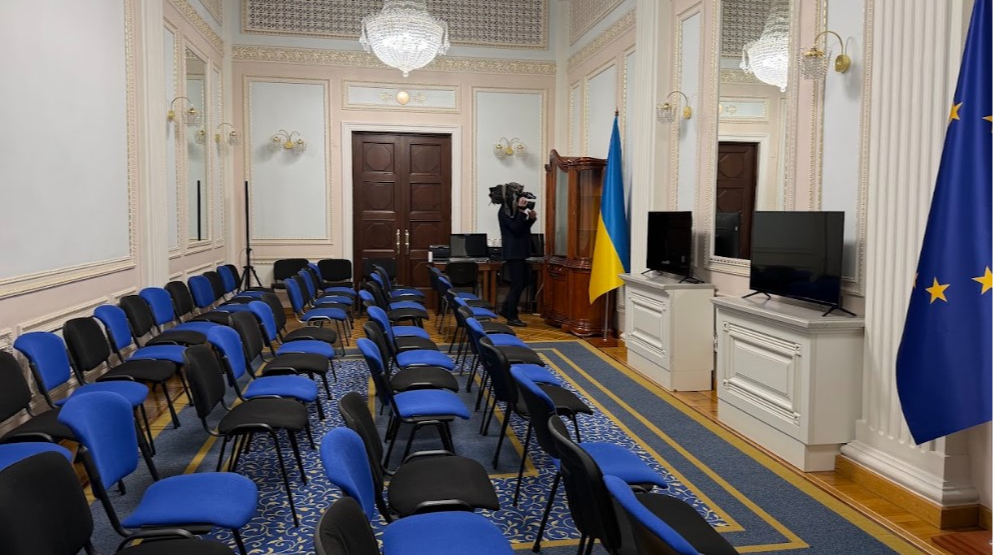
The Ukrainian parliament has taken two dramatic steps to adapt to the grinding reality of Russia’s full-scale war: moving its voting proceedings into an underground bunker and, on 15 September, voting unanimously to dismiss Prosecutor General Ruslan Kravchenko after he became the target of a corruption investigation.
Shelter democracy
On 1 September, Speaker Ruslan Stefanchuk announced that the Verkhovna Rada had set up 368 workstations for its 392 MPs in the conference hall and corridors of a basement shelter beneath the parliament building. The move, he said, was triggered by the increase in Russian missile and drone attacks on Kyiv. “We have developed an alternative electronic voting mechanism to preserve all procedural rules,” Stefanchuk told journalists, according to Ukrainska Pravda. He stressed that the constitution still requires votes to be taken in person, and only inside the Rada’s building. Until now, the administrative office had never needed to activate the shelter system, even though it has been working on it since the start of the invasion. The practical implication for the war-weary public is that critical legislation — including defence budgets, mobilisation laws and international agreements — will no longer be suspended mid-session every time an air-raid siren sounds.
The prosecutor general’s downfall
The vote on Kravchenko’s dismissal, which passed 317-0 on 15 September, caps a week of high drama inside Ukraine’s anti-corruption institutions. The National Anti-Corruption Bureau of Ukraine (NABU) and the Specialised Anti-Corruption Prosecutor’s Office (SAPO) had been investigating an alleged “protection racket” involving scam call centres — operations that typically defraud victims abroad and are often linked to organised crime. According to Ukrainska Pravda’s report on 14 September, Kravchenko responded by signing a notice of suspicion against NABU director Semen Kryvonos, accusing NABU and SAPO of unlawfully seizing case materials during searches conducted as part of “Operation Carthage” in order to block procedural decisions against their own staff.
President Volodymyr Zelenskyy swiftly suspended Kravchenko and called on parliament to dismiss him. The faction leader of the ruling Servant of the People party, David Arakhamia, confirmed on social media that a vote would be held on 15 September, and it was.
Kravchenko’s trip to Paris — and the unanswered questions
Adding a layer of political intrigue, Kravchenko reportedly left Ukraine in an official vehicle on the night of 13–14 September. He told Ukrainska Pravda that he was on an “official trip” to Paris for PACE hearings concerning Ukrainian children. But according to a document obtained by the outlet, while Kravchenko had sent himself on a five-day trip, he was not listed among the speakers on the event’s agenda. By the time the Rada voted, it was still unknown who was serving as acting prosecutor general, a situation opposition MPs said underscored the need for a competitive selection process for the post, rather than “politics-driven appointments”.
What it means operationally
The dual developments — shelter voting and the removal of a prosecutor general — are not directly linked, but they highlight two challenges Ukraine faces simultaneously: keeping the state functioning under daily bombardment, and maintaining the trust in anti-corruption bodies that is a condition of Western financial and military support. The NABU and SAPO investigations into the call-centre scandal are ongoing. The acting prosecutor general has not been named, creating a temporary leadership vacuum at one of the most sensitive law-enforcement posts in the country.
For the average Ukrainian, the sight of MPs voting from a basement is both reassuring and grim — a reminder that the war is not easing, but the institutions are bending rather than breaking. Whether the new system holds during sustained, hours-long air alerts remains to be seen. The Rada has designed capacity for 368 MPs, just 24 seats short of full attendance, a level rarely reached even in peacetime.
Further reporting will follow when the acting prosecutor general is officially announced and when NABU/SAPO provide details on the call-centre investigation.
Sources
- Ukrainian Parliament will work in shelter during air-raid warnings – photos September 1, 2026
- Ukrainian parliament approves dismissal of Prosecutor General Kravchenko September 15, 2026
- Ukraine's parliament to vote on Prosecutor General Kravchenko's resignation September 14, 2026
Part of the dossier
Ukrainian Parliament Operations in Wartime →